UPSC Weekly Current Affairs Quiz | March 15 to March 21, 2026
As UPSC CSE Prelims 2026 is just a few months away, current affairs should be your primary focus.
As UPSC CSE Prelims 2026 is just a few months away, current affairs should be your primary focus. UPSC Weekly Quiz is a current affairs–based quiz on relevant topics from the past week, curated for aspirants of competitive examinations. Attempt the weekly quiz every Saturday and find detailed answers to the MCQs with explanations. 🚨 Share your views and suggestions in the comment box or at manas.srivastava@indianexpress.com🚨 QUESTION 1 The methanol can be produced from: 1.
Coal
- Agricultural waste
- Captured Carbon Dioxide 4.
Sewage Treatment Plant Select the correct answer using the codes below: (a) 2, 3 and 4 (b) 1 and 2 only (c) 2 and 3 only (d) 1, 2, 3 and 4 Why this question for UPSC Prelims 2026? Methanol is in focus due to India’s push under the Methanol Economy Programme India for cleaner alternative fuels. It links directly with themes of waste-to-wealth, circular economy, and bioenergy, especially using agricultural residue and sewage.
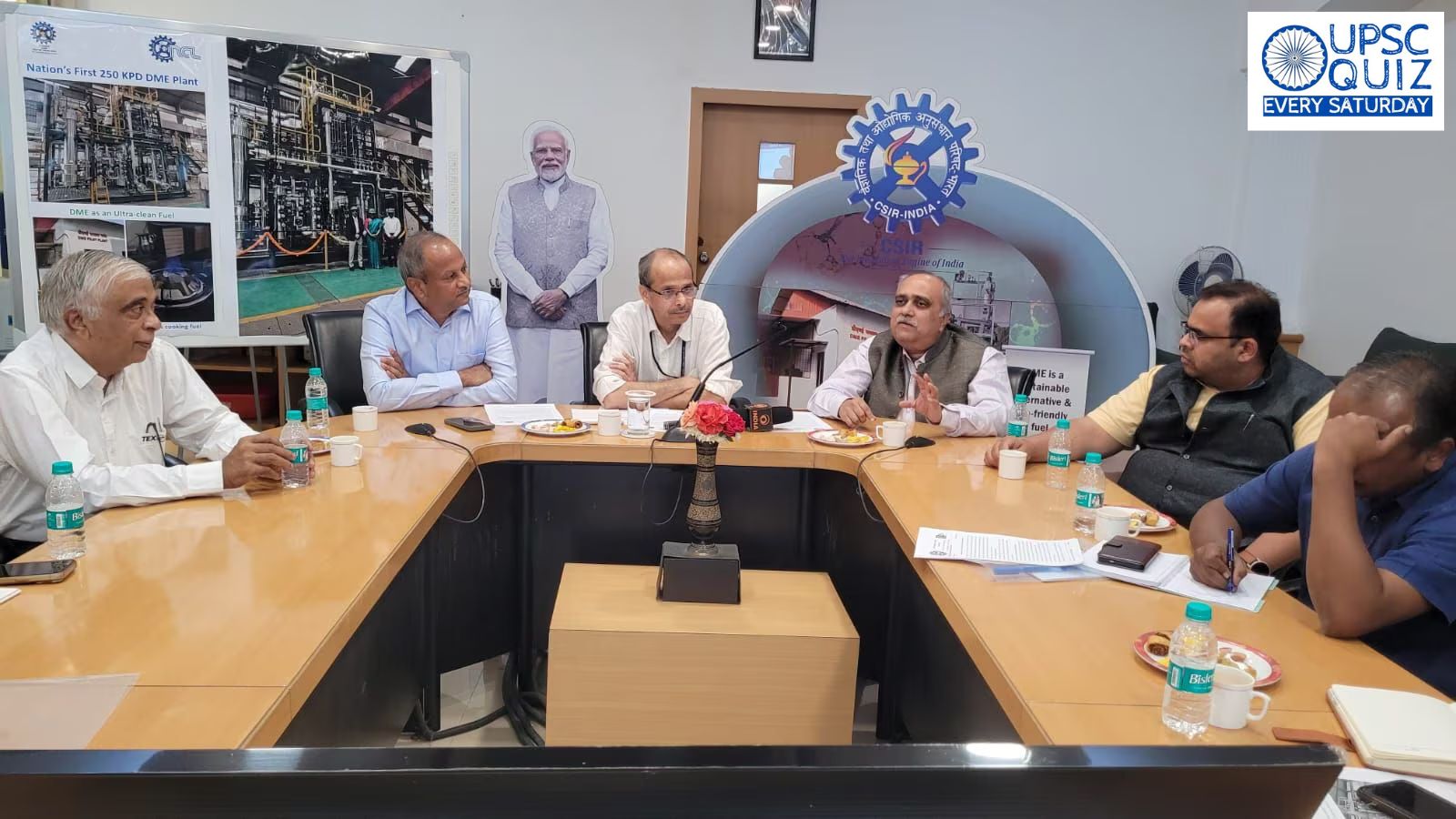
Explanation: — The Dimethyl Ether (DME) technology is a clean-burning fuel that can be produced domestically from sources such as methanol, coal, biomass, or even captured carbon dioxide.
Moreover, DME can be blended with LPG and used in stoves with little to no modifications. — The technology has already been tested on a semi-pilot scale (about 250 kg per day). This technology was developed over the past few years of research by scientists, focusing on both the catalyst and the process design. — India currently imports methanol from countries including Iran, which could pose a challenge.
However, Raja notes that methanol can be produced from several sources available domestically, such as coal, agricultural waste (biomass), Sewage Treatment Plants or even captured carbon dioxide. — Methane is the main part of natural gas. It does not directly produce DME, but serves as a starting material. It is first converted into syngas (CO and H2), and then into methanol, which is used to produce DME.
Methane can be sourced from both fossil fuels and renewable sources, DME production is flexible and future-ready. Therefore, option (d) is the correct answer. QUESTION 2 With reference to the Western Disturbances, consider the following statements: 1.
These are rain-bearing wind systems, originating beyond Afghanistan and Iran. 2. They pick up moisture majorly from the Arabian Sea as they move eastward towards India.
- The Western Disturbances trigger rain in the northwest and northern parts of India. Which of the statements given above is/are correct?
(a) 1 and 3 only (b) 1 only (c) 3 only (d) 1, 2 and 3 Why this question for UPSC Prelims 2026? Western Disturbances are frequently in news due to unseasonal rainfall, hailstorms, and their impact on rabi crops, making them highly relevant for current affairs-based prelims questions. Questions help test conceptual clarity between Western Disturbances and monsoon systems, a common area for UPSC traps.
Explanation: — Western Disturbances are rain-bearing wind systems, originating beyond Afghanistan and Iran. Hence, statement 1 is correct. — The western disturbances pick up moisture from the Mediterranean Sea, the Black Sea, the Caspian Sea and the Arabian Sea as they move eastward towards India. Their primary moisture source is the Mediterranean region.
Hence, statement 2 is not correct. — Since November last year, the Western Disturbance streams affecting India have been subdued in both frequency and intensity, directly affecting rainfall and snowfall. — The Western Disturbances trigger rain (and snowfall in higher altitudes) in the northwest and northern parts of India during the non-monsoon months (June-September). Hence, statement 3 is correct. Therefore, option (a) is the correct answer.
QUESTION 3 Consider the following statements about Global Warming Potential (GWP): Statement 1: To convert methane emissions into CO₂ equivalent (CO₂e), the amount of methane emitted (in tonnes) is multiplied by a factor called the Global Warming Potential over 100 years (GWP100). Statement 2: This factor represents how much warming methane causes compared with carbon dioxide over a 100-year period. Which one of the following is correct in respect of the above statements?
(a) Both Statement 1 and Statement 2 are correct and Statement 2 is the correct explanation for Statement
- (b) Both Statement 1 and Statement 2 are correct and Statement 2 is not the correct explanation for Statement
- (c) Statement 1 is correct but Statement 2 is incorrect.
(d) Statement 1 is incorrect but Statement 2 is correct. Why this question for UPSC Prelims 2026? Global Warming Potential (GWP) is widely used in climate reports of the Intergovernmental Panel on Climate Change, making it a core concept in environmental science.
It frequently appears in news due to debates on methane reduction targets, carbon accounting, and net-zero commitments. Explanation: — Climate policy uses a common unit to compare different greenhouse gases. That unit is called carbon dioxide equivalent, or CO2e.
Since carbon dioxide is the benchmark gas, other gases such as methane are converted into CO2e using a multiplier called Global Warming Potential, or GWP. For more than 30 years, the world has mostly used GWP100, which measures the warming impact of a gas over a 100-year period. Under this system, one tonne of methane is assigned a fixed CO2-equivalent value. — To convert methane emissions into CO₂ equivalent (CO₂e), the amount of methane emitted (in tonnes) is multiplied by a factor called the Global Warming Potential over 100 years (GWP100).
This factor represents how much warming methane causes compared with carbon dioxide over a 100-year period. For methane, this value is approximately 28, meaning methane has about 28 times the warming impact of CO₂ over 100 years. Hence, statements 1 and 2 are correct. — Methane and carbon dioxide behave very differently in the atmosphere.
Methane is powerful but short-lived. Carbon dioxide is less intense in the short run but lasts much longer. When methane is averaged over 100 years, much of its near-term impact gets diluted.
That means a methane cut made today may look less valuable on paper than it is in the atmosphere. Both Statement 1 and Statement 2 are correct and Statement 2 is the correct explanation for Statement 1. Therefore, option (a) is the correct answer.
QUESTION 4 The conflict that has broken out in West Asia after the US and Israel attacked Iran, prompted the CBSE to cancel class 10 and 12 board exams across:
- UAE
- Iran 3.
Egypt
- Kuwait
- Qatar Select the correct answer using the codes given below: (a) 2, 3, 4 and 5 (b) 1, 2, 4 and 5 (c) 1, 2 and 4 only (d) 1, 2, 3, 4 and 5 Why this question for UPSC Prelims 2026?
The question is based on recent geopolitical tensions in West Asia, a highly dynamic and frequently tested area. It highlights how global conflicts impact Indian diaspora and institutions abroad, including CBSE-affiliated schools. Explanation: — The conflict that has broken out in West Asia after the US and Israel attacked Iran, prompted the CBSE to cancel class 10 and 12 board exams across seven countries in the region.
India’s largest national school board had around 52,000 students registered for the class 10 and 12 exams in these countries. — The class 10 and 12 CBSE board exams began on February 17.
Source Verification
Corroboration Score: 1This story was independently reported by 1 sources. Click any source to read the original article.