Will Lebanon Survive an Operation to Remove Hezbollah?
With the Middle East in the throes of its most expansive war in decades, Lebanon is once again caught in the crossfire as Israel pursues a renewed air and ground offensive in response to Hezbollah's strikes in support of its Iranian Islamic Republic ally's fight for survival. But the current confli
With the Middle East in the throes of its most expansive war in decades, Lebanon is once again caught in the crossfire as Israel pursues a renewed air and ground offensive in response to Hezbollah's strikes in support of its Iranian Islamic Republic ally's fight for survival. But the current conflict poses a risk potentially more dire for the Lebanese state than at any point since the 15-year bloody civil war that tore through the nation until 1990. Since then, a precarious power-sharing system has prevailed across sectarian lines, informally allowing Hezbollah, an Iran-backed Shiite Muslim political and paramilitary movement born out of resistance to Israeli occupation in the midst of that internal conflict, to retain a standing army and vast arsenal of advanced weapons to rival that of the Lebanese Armed Forces (LAF).
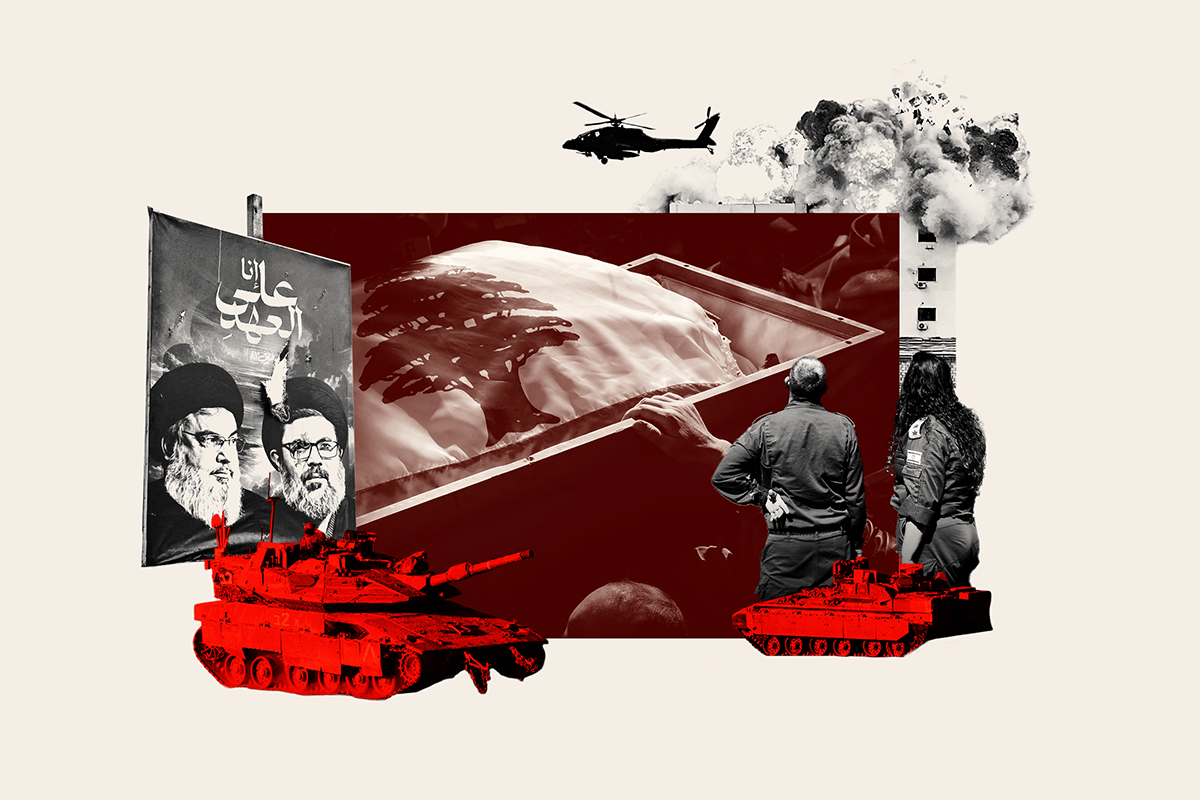
After three Israel-Lebanon wars, the latest sparked by the Palestinian Hamas movement's attack against Israel in October 2023, Israel is now looking to capitalize on a wave of regional upheaval emanating from the conflict in Gaza in order to realize the permanent disarmament of Hezbollah, which, like Hamas, is considered by both Israel and the United States to be a terrorist organization. And while the Israel Defense Forces (IDF) has already intensified cross-border operations in response to the group's first rocket fire since a November 2024 truce, both Israeli Prime Minister Benjamin Netanyahu and U.S. President Donald Trump are placing pressure on the Lebanese government to play a decisive role in restricting Hezbollah's military activities by empowering the LAF to disarm the group, a prospect that threatens the cohesiveness of an already strained Lebanese state. Karim Émile Bitar, an associate professor at Saint Joseph University of Beirut and associate research fellow at the Institute for International and Strategic Affairs in Paris, warned of "serious risks in expecting the LAF to confront Hezbollah directly." "
The army remains the last genuinely cross-sectarian institution in Lebanon and one of the very few that still enjoys a broad degree of public trust," Bitar told Newsweek. "
Using it to fight Hezbollah could expose it to a dangerous internal fracture. Hezbollah is not simply a militia but also a major political actor with a large social base within the Shiite community, and many Lebanese soldiers themselves come from that community." "
If the LAF were ordered to engage Hezbollah militarily, it could create a 'double bind' situation for the army: either it obeys political directives and risks internal division and even mutiny, or it refuses and undermines the authority of the state," Bitar said. "
Either scenario would weaken one of the last pillars of national cohesion." "
More broadly, such a confrontation would risk transforming a regional war into a Lebanese civil conflict." A Tale of Two Armies The LAF was established in its current form in 1991, a year after the Taif Agreement put an end to the Lebanese Civil War and called for the disbanding of all militias and the surrender of heavy weapons. That accord had a key caveat, however, allowing Hezbollah to remain as a "resistance force" engaged in attempts to expel Israeli forces, which invaded the country in 1982 in a bid to uproot Palestinian militias operating in southern Lebanon.
The IDF withdrew in 2000, with its allied South Lebanon Army quickly collapsing, allowing Hezbollah to retain a powerful presence across the south and in other majority-Shiite Muslim areas such as southern Beirut and the eastern Beqaa Valley. In 2006, a year after popular protests expelled heavy Syrian influence over Lebanon, war returned as Israel and Hezbollah engaged in a monthlong conflict set off by a Hezbollah ambush against Israeli troops along the border. The United Nations Security Council resolution that ended that conflict called for the disarmament of Hezbollah as well, along with the withdrawal of the IDF and the deployment of the LAF in the south.
In practice, Hezbollah consolidated its presence, expanded its support base and amassed a growing arsenal of weapons, including rockets, mortars, drones and even precision-guided missiles, while Israel routinely penetrated Lebanese airspace and waters. After years of intermittent clashes, the war in Gaza brought the deadliest battle yet between Israel and Hezbollah, which suffered extensive losses—including the killing of Secretary-General Hassan Nasrallah, who had led the group since 1992—and ultimately signed a ceasefire in November 2024. Israel continued to regularly strike across Lebanon as regional conflict persisted, with Hezbollah rejoining the battle two weeks ago in response to the killing of Iranian Supreme Leader Ayatollah Ali Khamenei in U.S.-Israeli strikes that brought direct war to Iran.
The LAF has thus far sought to remain neutral throughout the conflict, even as it lost several soldiers in Israeli strikes, including three reportedly killed on Tuesday. That neutrality is now under pressure as Netanyahu recently warned the Lebanese government that "
Hezbollah’s aggression will bring catastrophic consequences upon Lebanon" if the group is not disarmed. But even a Lebanese government with top figures who have openly called for reining in Hezbollah now at the helm —including President Joseph Aoun, former commander of the LAF, and Prime Minister Nawaf Salam—finds itself in a difficult position, risking the unraveling of a crucial and elusive cornerstone of Lebanese unity. "
The risks of using the Lebanese Army against Hezbollah in the middle of an ongoing regional war are extremely high, and they are not only military risks but political and communal ones," Amal Saad, a lecturer at Cardiff University's School of Law and Politics in Wales, told Newsweek. "
The army has historically tried to stay out of direct confrontation between Hezbollah and Israel, and the reason is obvious: once the army is seen not as a national institution but as an instrument in an internal anti-Hezbollah campaign, it risks fracturing its legitimacy, especially in Shiite areas, and potentially reopening the specter of internal strife." Saad, a leading expert on Hezbollah and a veteran Lebanese scholar with direct experience in instructing senior LAF officials, warned such a rift may not be limited to Shiites, but also other sects such as Sunni Muslims and Christians, recalling how both mid and high-ranking LAF personnel of various backgrounds routinely referred to Israel as "the enemy." The LAF and Hezbollah have cooperated in the past, dividing labor on both sides of the Lebanese-Syrian border to battle the Islamic State militant group (ISIS) after the group first took root there in 2014.
There is also precedent for Lebanese troops refusing to disarm Hezbollah amid soaring tensions, as occurred after May 2008, when deadly weeklong clashes between Shiite and Sunni Muslim militias stemming from a dispute over Hezbollah's telecommunications network previously fueled fears of another all-out civil war. "
The idea of large sections of the army effectively doing Israel’s dirty work for it, in the midst of an Israeli invasion no less, is absurd," Saad said. "
And needless to say, if Israel can’t disarm Hezbollah then how on earth could the most underequipped army in the entire Middle East fare?" "
It’s also important to add that if LAF commander Rudolf Haykal were replaced under U.S. pressure, and a showdown were ever attempted, Hezbollah would not shy away from confronting the army," she added, "and this has been insinuated in previous interviews with Hezbollah officials.
Source Verification
Corroboration Score: 1This story was independently reported by 1 sources. Click any source to read the original article.
Comments
0 commentsJason Bateman to Direct Woody Harrelson, Sam Rockwell in ‘The Cackling of the Dodos’
What you need to know about Iran today, with Matthew Doran
Related Articles
 Politics
Chinese minister says power politics has no future
 Politics
NYC’s crackdown on reckless e-biker riders is over as Mamdani pumps the brakes
 Politics