Palm oil clearing advances in Bornean orangutan habitat despite red flags
JAKARTA — A palm oil company is ramping up its destruction of forests that are home to critically endangered orangutans in a UNESCO Biosphere Reserve on the island of Borneo, according to satellite imagery and government sources.
JAKARTA — A palm oil company is ramping up its destruction of forests that are home to critically endangered orangutans in a UNESCO Biosphere Reserve on the island of Borneo, according to satellite imagery and government sources.
In October 2025, Mongabay reported that PT Equator Sumber Rezeki (ESR) had clear-cut 1,376 hectares (3,400 acres) of forest between January and August 2025, based on satellite image analysis by Satya Bumi, an Indonesian environmental nonprofit. Prior to that, ESR had cleared no more than 195 hectares (482 acres) of forest. The company is operating within a 15,000-hectare (37,000-acre) oil palm plantation concession in Kapuas Hulu, a district in Indonesia’s West Kalimantan province.
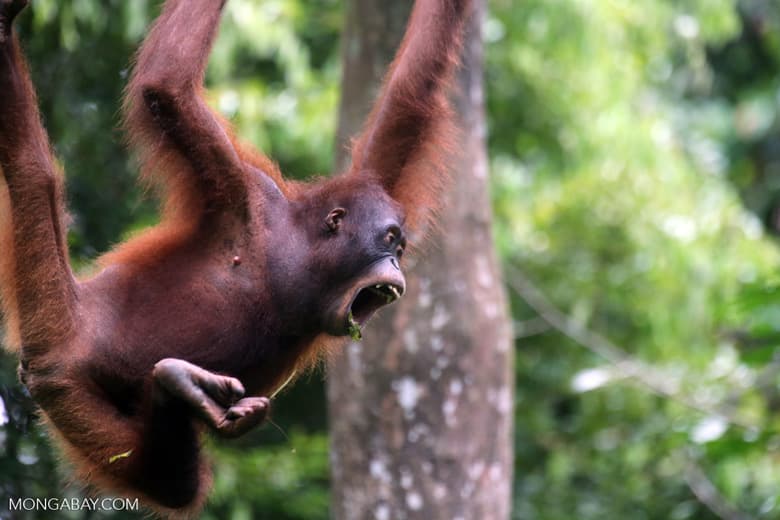
Now, an updated analysis by Satya Bumi shows that ESR further accelerated its rainforest clearing in the final quarter of 2025, razing an additional 1,492 hectares (3,687 acres) of forest from October to December. It has now cleared a total of 3,063 hectares (7,569 acres) of forest within its concession, according to Satya Bumi. ESR’s concession overlaps with part of the Labian–Leboyan watershed, a wildlife corridor connecting Betung Kerihun and Danau Sentarum national parks — two of the last strongholds for the critically endangered Bornean orangutan (Pongo pygmaeus).
The corridor and parks form part of the UNESCO-designated Betung Kerihun–Danau Sentarum Biosphere Reserve, whose forests sustain hundreds of species of wildlife, including sun bears, hornbills and giant rafflesia flowers. They also provide water, food and livelihoods for Indigenous Dayak communities whose cultures are closely tied to the land. Indonesia’s Ministry of Forestry told Mongabay in January it had become aware of the deforestation by ESR from a Mongabay social media post in September 2025.
A subsequent field inspection by the Betung Kerihun and Danau Sentarum national park authorities confirmed that ESR was indeed logging the forest inside its concession and that there were pockets of orangutan habitat also located inside the concession.
According to Satya Bumi, 1,892 hectares (4,675 acres) of the forest cleared in 2025 was identified as orangutan habitat in a 2016 population and habitat viability analysis. This is a regular assessment involving government authorities and scientists, Satya Bumi told Mongabay. The analysis placed the total area of orangutan habitat within the land now included in ESR’s licensed area at nearly 4,000 hectares (about 10,000 acres).
The forestry ministry told Mongabay in January it had identified 7,335 hectares (18,125 acres) of orangutan habitat within the concession. It did not say whether any of this had been cleared by ESR. Satya Bumi said the ministry’s higher figure might be attributable to its use of more recent data, which the nonprofit doesn’t have access to.
Field surveys by Indonesian NGO LinkAR Borneo recorded at least 10 orangutan nests in the concession, the group said in a statement. All 10 are located in Labian village, LinkAR Borneo researcher Raden Deden Fajarullah told Mongabay. First Borneo, the Jakarta-based conglomerate that owns ESR, did not respond to questions.
The deforestation has raised alarm among environmental groups, which warn that without immediate intervention, the activity could accelerate habitat fragmentation and increase human-wildlife conflict. Just 104,700 Bornean orangutans are thought to remain in the wild, down from about 200,000 in 1999, according to WWF.
“Entering early 2026, these findings serve as a stark warning to the government, law enforcement authorities, and plantation companies,” Riezcy Cecilia Dewi, a campaigner with Satya Bumi, said in a statement.
“Without firm action to stop deforestation and protect orangutan habitat, Indonesia’s commitment to biodiversity protection and sustainable forest management will continue to be questioned.” Orangutans under siege In a written statement to Mongabay, the management authority for the two national parks acknowledged the presence of orangutan habitat and the corridor’s ecological function inside ESR’s concession. But it did not identify any plan to halt or pause ESR’s clearing activities to protect the habitat.
Instead, the national park authority said proposals had been made to designate orangutan habitat pockets outside the concession as preservation areas, while habitat pockets located inside the concession would be proposed as areas of high conservation value (HCV). Cooperation mechanisms for managing the habitat pockets would also be established. HCV is a land management concept used to identify and protect areas with critical ecological or social importance inside production landscapes such as oil palm and industrial timber concessions.
In Indonesia, HCV is not a formal land-use category under zoning laws. As such, any HCV set-aside inside ESR’s plantation would require the company’s agreement to preserve and would function as a voluntary conservation commitment rather than a statutory prohibition on land clearing — unless it’s reinforced through certification or contractual supply-chain requirements. The Teraju Foundation, an Indonesian nonprofit, says “up to 80%” of the concession meets HCV standards like those put forth by the HCV Network, a network of NGOs and companies working to advance the methodology.
Any orangutan habitat would be a shoo-in for HCV status under any reasonable criteria, primate researcher Wanda Kuswanda of Indonesia’s National Research and Innovation Agency (BRIN) told Mongabay. Designating an area as HCV can help orangutans when implemented properly, but does little good when treated as a box-ticking exercise, Wanda said. In landscapes such as the Betung Kerihun–Danau Sentarum corridor, HCV areas truly benefiting orangutans would need to be fairly wide and connected to protected forests rather than to isolated patches established only to meet minimum percentage requirements.
“The key is that the wider the corridor, the greater the potential to strengthen orangutan populations,” Wanda said. Satya Bumi said the ESR case highlights deeper flaws in Indonesia’s plantation licensing system, notably the failure to properly integrate biodiversity data into zoning plans and permit issuance from the outset.
“The fact that most of the [concession] overlaps with orangutan habitat shows that habitat protection was not a primary consideration from the beginning,” the group said, warning that any future HCV designation in the ESR concession risks becoming a symbolic corrective layered over damage that’s already occurred. If the government and ESR are genuinely committed to protecting orangutan habitat inside the concession, the company should reallocate, restrict or even relinquish parts of its licensed area, Satya Bumi added. Land conflicts Village officials from some communities located inside ESR’s concession told Mongabay last September that they never agreed to let the company use their land and were surprised to find that parts of their territory had been included in its license without their consent.
At least five villages — Senunuk, Setulang, Labian, Labian Ira’ang and Mensiau— have territories that overlap with ESR’s license area. Besides obtaining government permits, palm oil firms must also negotiate with local landowners for the right to use their land. But Indonesia’s Indigenous communities typically hold land communally, and they often lack government land titles.
And while Indonesian villages have elected leaders, they also make important decisions — such as whether to hand over land to a corporate developer — through a consensus-based method known as musyawarah. A well-documented tactic for companies seeking land in a village that may not want to do business with it or whose residents are divided on the matter is to fraudulently buy the land from someone falsely claiming the rights to it.
Source Verification
Corroboration Score: 1This story was independently reported by 1 sources. Click any source to read the original article.
Comments
0 commentsMorgan Stanley names top auto pick if gas prices stay high
New COVID variant ‘Cicada’ spreads across US: Symptoms, spread and vaccine response
Related Articles
Morgan Stanley names top auto pick if gas prices stay high
 Business
Jason Whitlock goes scorched earth over Stephen A. Smith HBCU credentials
 Business